
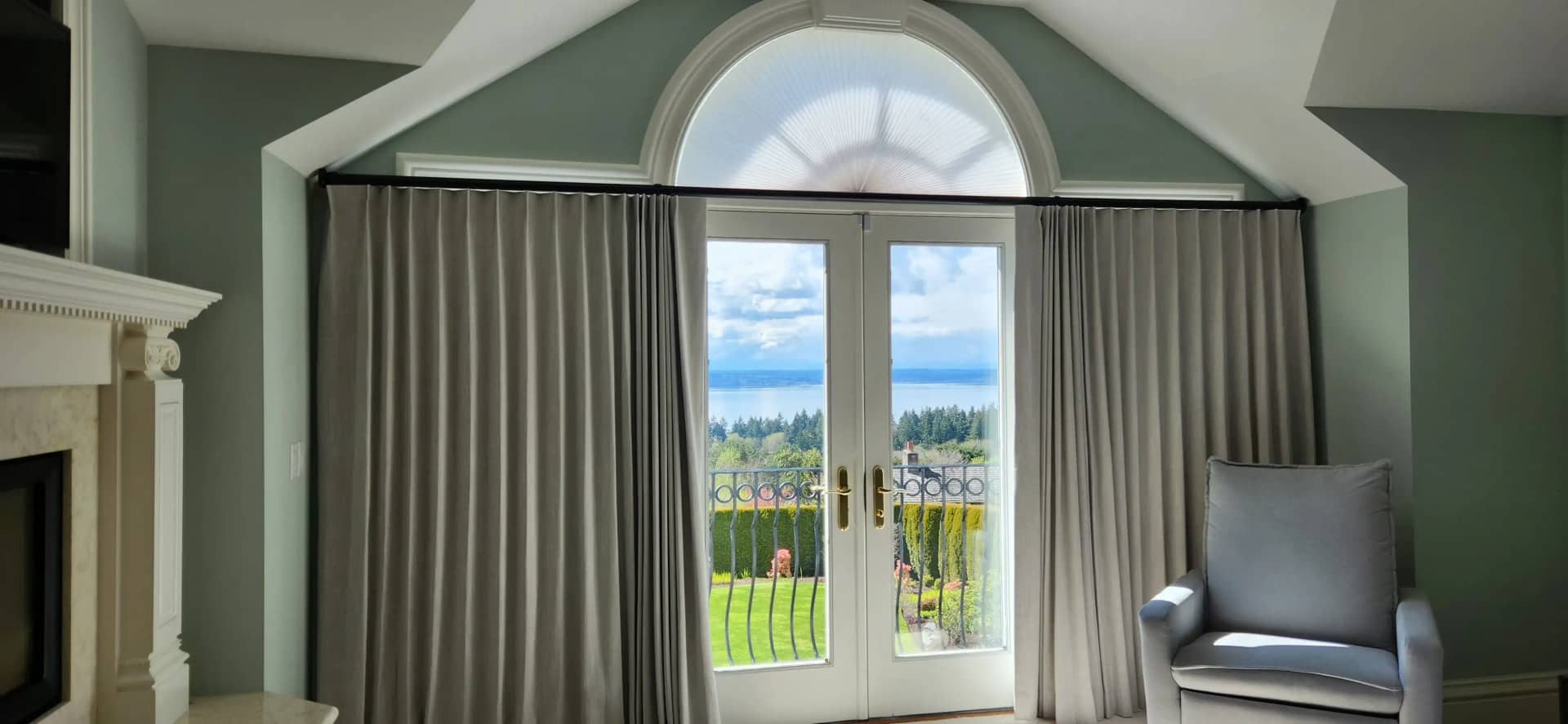
Custom Window Treatment Projects
What to Look For in a Finished Window Treatment
When you look through these projects, do not worry about identifying every product by name. Look at what happened to the room. Notice how much glass stayed visible, how the treatment sits against the trim, whether the window feels softer or cleaner, and how much visual weight the finished treatment adds.
If you keep stopping on the same kind of shade, fabric, texture, or layered look, that is useful. Bring that reaction into the consultation. We can work backward from what you like and what the window needs to do.
Look at proportion
A treatment has to fit the scale of the opening and the room around it. On a smaller window, too much visual weight can make the treatment feel crowded. On a broad or tall opening, something too delicate can look undersized or become difficult to operate.
Pay attention to how far a treatment extends past the glass, how much of the window stays visible when it is open, and whether the finished installation feels like part of the room rather than something added afterward.
Look at the light
Photos can also help you think about how much light you want to keep. Some rooms benefit from a softer filtered glow. Others need stronger glare control, room darkening, or adjustable slats that can redirect light without fully covering the window.
The right answer is rarely just about adding more coverage or less coverage. It is usually about how the room is used at different times of day and how the treatment changes that use.
Notice texture and layering
Fabric shades, woven materials, blinds, shutters, and drapery all bring a different amount of texture into a room. A clean roller shade can stay visually quiet. Drapery can soften a larger wall. A woven shade can add warmth. Layering can combine practical light control with a more finished look.
If you find yourself repeatedly drawn to the same kind of texture, fold, material, or amount of softness in the gallery, that is useful information to bring into the consultation even if you do not know the product name.
Start with the problem
The strongest projects solve something specific. A bedroom may need better darkness and privacy. A living room may need glare control while keeping daylight. A large opening may need easier operation. A street-facing room may need coverage that changes between day and night.
When you know what the window needs to do, product selection becomes much easier. The gallery can help you picture the finished room, but the final recommendation still starts with function.
Blinds, Shades, Drapery & More in Real Homes
Browse completed window treatment projects from real homes. Look at how different shades, blinds, drapery, and layered treatments change the light, privacy, proportion, and feel of the room.
Select a photo to view it larger
From Samples to a Finished Installation
A finished photo is the last step of a much longer decision. Before a treatment reaches the window, the room, the opening, the light, and the way the homeowner uses the space all need to be understood.
See the room first
The consultation happens in your home so the decisions can be made against the actual flooring, paint, trim, furniture, daylight, and outside exposure. That is more useful than trying to imagine how a small sample will behave in a completely different environment.
Narrow the product choices
Once the practical needs are clear, the options can be narrowed to products that make sense for the room. That may include blinds, roller shades, cellular shades, Roman shades, woven shades, shutters, drapery, motorized treatments, or a layered combination.
We do not need to drag every sample into the room. Once we know what the window needs to do, a lot of options can be ruled out quickly.
Measure the actual opening
Window depth, trim, handles, adjacent walls, furniture, and mounting space all affect the finished result. Accurate measuring helps determine whether an inside mount, outside mount, shutter frame, drapery treatment, or another approach will operate cleanly.
Finish with professional installation
Installation is where the planning becomes visible. Treatments need to sit level, clear the surrounding window details, operate properly, and look intentional from across the room. The result should feel finished without calling attention to the mechanics that made it possible.