
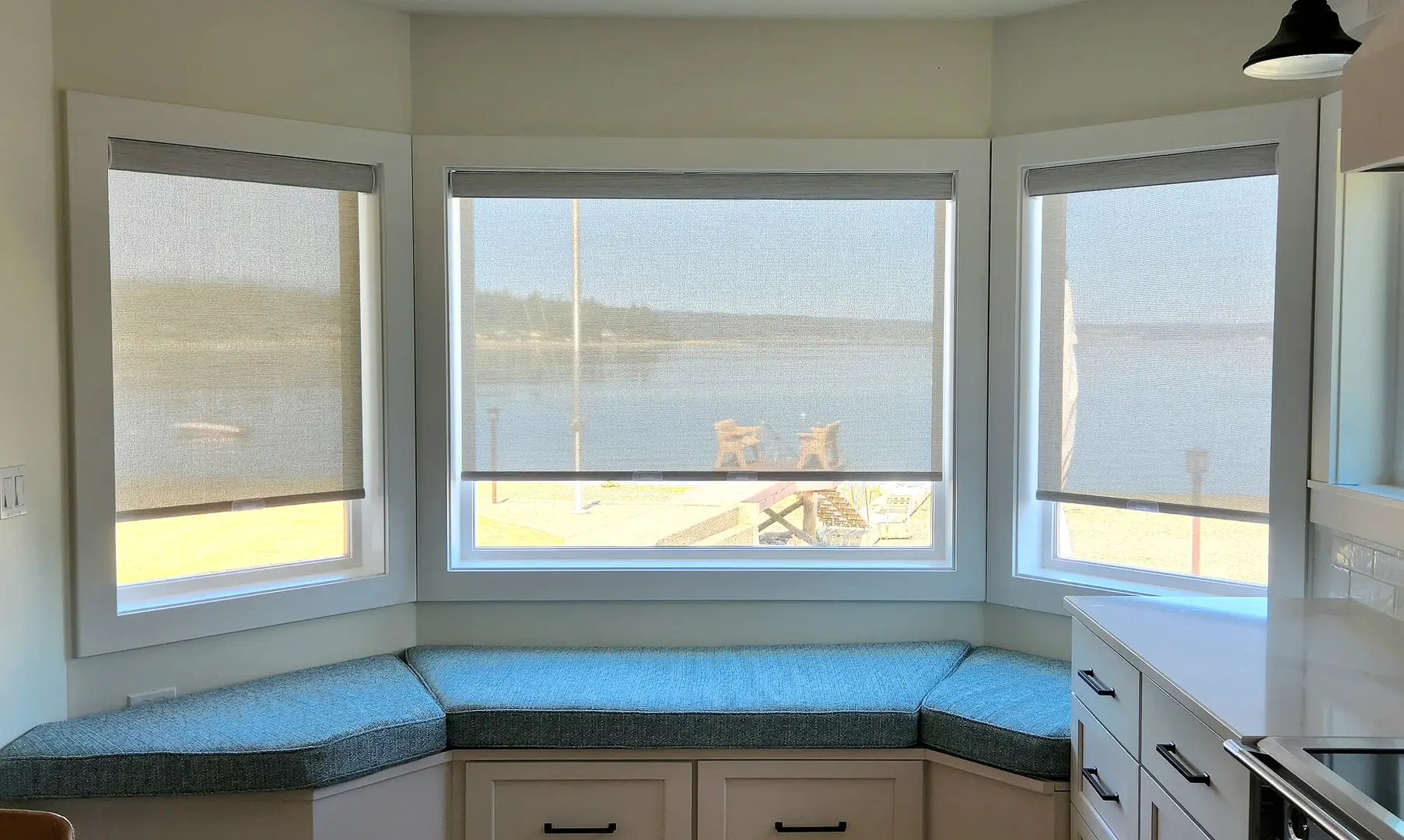
How to Reduce Glare While Keeping Your Puget Sound View
Large windows are one of the best parts of many Tacoma homes, especially when the room opens toward Puget Sound, Commencement Bay, or another broad outdoor view. The challenge is that the same glass that makes the room feel open can also create intense glare, reflected light, heat near the window, and uncomfortable brightness at certain times of day.
Most homeowners do not want to solve that problem by covering the view all afternoon. The better goal is to reduce the light that is causing the problem while keeping as much of the room's openness as possible.
That usually starts with understanding when the glare happens, how direct the exposure is, and how much outside visibility you want to preserve while the treatment is down.
Start With the Time of Day
Glare is not the same in every room or at every hour.
A window may feel completely comfortable in the morning and become difficult by late afternoon. Water, light-colored buildings, neighboring roofs, and other reflective surfaces can increase brightness even when the sun is not shining directly through the glass.
Before choosing a treatment, pay attention to a few things:
- What time the glare becomes noticeable
- Whether the light is direct or reflected
- Which part of the room becomes difficult to use
- Whether the problem is mainly on television or computer screens
- How much of the outside view you want to keep while the treatment is closed
- Whether privacy becomes more important later in the day
Those details help determine whether you need light filtering, stronger solar control, adjustable slats, room darkening, or a layered treatment.
Solar Shades Can Reduce Brightness Without Hiding Everything
Solar shades are one of the most useful options when the priority is controlling glare while preserving daytime visibility.
The fabric is designed to reduce incoming light and ultraviolet exposure while allowing different amounts of view through the material. The amount you can see through the shade depends on the exact fabric, color, and openness.
I prefer to compare solar materials in the actual room because a small sample can look very different once it is covering a large window.
A solar shade may help:
- Reduce harsh brightness
- Improve television and computer visibility
- Reduce heat near large expanses of glass
- Limit some ultraviolet exposure to flooring, furniture, rugs, and artwork
- Preserve more of the daytime view than an opaque shade
The tradeoff is privacy. A material that preserves a strong daytime view is not necessarily private at night when the lights are on inside.
Openness Matters More Than the Name of the Fabric
Two solar shades can look similar in a sample book and behave very differently on the window.
A more open fabric generally preserves more of the outside view but allows more light through. A tighter fabric generally provides stronger glare control but reduces visibility.
Color matters too. Darker solar fabrics often provide clearer daytime visibility through the material, while lighter fabrics can reflect more light and create a softer appearance from inside the room.
There is no single openness percentage that is right for every Puget Sound view. The best choice depends on the direction of the window, the intensity of the light, the room's use, and how much view you are willing to trade for stronger control.
Blinds and Shutters Give You Adjustable Angles
Solar shades filter light through fabric. Blinds and shutters control light differently by changing the angle of the slats or louvers.
That can be useful in rooms where the light changes throughout the day. Instead of raising or lowering the whole treatment, you can redirect the incoming light while keeping part of the window covered.
Blinds can work especially well in:
- Home offices
- Bedrooms
- Street-facing rooms
- Living spaces where privacy changes during the day
Shutters provide a more architectural version of the same basic idea, but the window depth, trim, handles, and panel clearance all need to work with the shutter frame.
Daytime View and Nighttime Privacy Are Different Problems
This is one of the most important things to understand when you want both privacy and a view.
During the day, the outside is often brighter than the inside, so some semi-open fabrics can make it harder to see into the room while still allowing you to see out.
At night, the condition reverses. Once the room is brighter than the outside, that same fabric may provide very little privacy.
If nighttime privacy matters, a second layer may be needed. That could be drapery, a more opaque secondary shade, a blind, or another treatment that can close completely after dark.
Trying to make one very open solar material solve both daytime view preservation and nighttime privacy usually leads to disappointment.
Layering Gives You More Than One Level of Control
Layering works well when the room needs different things at different times.
A common combination is a solar shade for daytime glare control with drapery for evening privacy. Another approach may pair a light-filtering shade with side panels or a second treatment that provides stronger coverage when needed.
The benefit is flexibility. You do not have to choose between keeping the view all day and having privacy at night.
Layering can also help a large window feel more finished without making the room look heavy.
Motorization Can Make View Windows Easier to Use
Large windows are often the windows people are least likely to adjust manually, especially when there are several treatments across the same wall.
Motorization can make sense when:
- The windows are tall or difficult to reach
- Several shades need to move together
- Furniture blocks easy access
- The shades are adjusted repeatedly as the sun moves
- You want to raise the treatments fully when glare is not a problem
A treatment only helps if it is convenient enough to use. If the shades stay down all day because they are annoying to adjust, the room loses the view you were trying to preserve.
Protecting Floors, Furniture, and Interior Finishes
Glare is the most noticeable problem, but strong sunlight can also affect the materials inside the room over time.
Flooring, rugs, upholstery, artwork, wood finishes, and fabrics may fade with repeated exposure. A treatment that reduces ultraviolet exposure can help limit that process, although no interior shade eliminates all fading.
If you have a room with expensive finishes or strong exposure, it is worth considering protection as part of the decision instead of focusing only on what the window treatment looks like.
Think About the Room, Not Just the Window
The right treatment for a living room view may be completely different from the right treatment for a bedroom with the same exposure.
A living room may prioritize glare reduction and daytime visibility. A bedroom may prioritize privacy and darkness. A home office may need precise screen-glare control. A dining room may need something softer that still lets the room feel open.
The same house can use several different treatment types and still feel coordinated.
Compare the Material in the Actual Light
For view windows, I would not choose a fabric solely from a catalog photo.
The best way to understand a solar or light-filtering material is to hold it up at the actual window and look through it from the room. You can immediately see how much brightness it cuts, how much of the view remains, and whether the color feels right with the rest of the space.
That is one of the biggest advantages of an in-home consultation. You can make the decision with the actual view in front of you.
Keep the View Worth Having
A great view is not much of an advantage if the room is uncomfortable every afternoon. The answer is usually not to cover the glass all day, either.
Watch where the glare comes from and when it becomes a problem. Then decide how much visibility you want to keep while the treatment is down. Once those two things are clear, solar shades, blinds, shutters, drapery, or motorization become much easier to compare.